Reading
Before I implemented my intervention, I was reading the book Skärmhjärnan (Screen Brain) by Anders Hansen.
Why can’t we let go of our mobile phones? This question haunts Anders Hansen, Sweden’s leading mental health expert, who builds on his research and creatively combines brain science, human evolution, and psychology to dissect why gadgets and social media make us more prone to anxiety, depression, difficulty concentrating, wasted time, poorer sleep, worse moods, and lower IQs. Children in their formative years face more serious consequences than adults who are led around by their mobile phones every day, and this book offers further advice on care and discipline to save the physical and mental health of young people.
We touch our mobile phones a whopping 2,600 times a day and pick them up every 10 minutes of our waking hours to look at them. 1 in 3 of us will wake up in the middle of the night and look at our phones too. It’s no exaggeration to say that mobile phones are attention crushers, because even when on silent, they are still distracting us, and they rob us of our attention just by being there.
Being addicted to social networks is essentially a gambling mentality. Some biologists have done experiments: train a monkey to do an action and then feed it a piece of food. If you give the monkey food every time, then the monkey will not be as motivated. But if you give it once and don’t give it the next time, then the monkey will be more motivated when it is being trained, and it will be more submissive to the feeder in anticipation of getting the food.
Why are people addicted to social networking? Because like the monkey being fed, people love the sense of uncertain surprise that social platforms bring. Mobile phones use dopamine, a neurotransmitter, to stimulate our pursuit and guide distraction. Prolonged mobile phone play can lead to dopamine dysregulation, distraction, and structural damage to the brain. Lying on the couch watching short videos for 2 to 3 hours, dopamine has peaked. There must be peaks and valleys, and when you put down your phone to work or study, dopamine levels decrease, our motivation decreases with it, and one become lazy and mentally depressed.
This variable reward is irresistible and, like monkeys, is an instinctive response. The scary thing is that if this state of life is continued, we will be deprived of concentration, the blue light from our mobile phones will affect our appetite, stimulating hormones make the body store more fat, and in severe cases, we may even suffer from depression.
In the book, the author shares some practical tips to get rid of mobile phone kidnapping:
- Monitor the screen usage time
- Set the background of your mobile phone to black and white
- Buy alarm clocks and watches
- Silence your phone and put it away when you are with friends
- Switch off mobile phones and electronic devices one hour before bedtime
- Uninstall social media apps from your phone and only view them on your computer
- Increase physical activity to release stress and improve concentration
I think these tips are very helpful to try to implement in intervention in conjunction with previous research.

First intervention
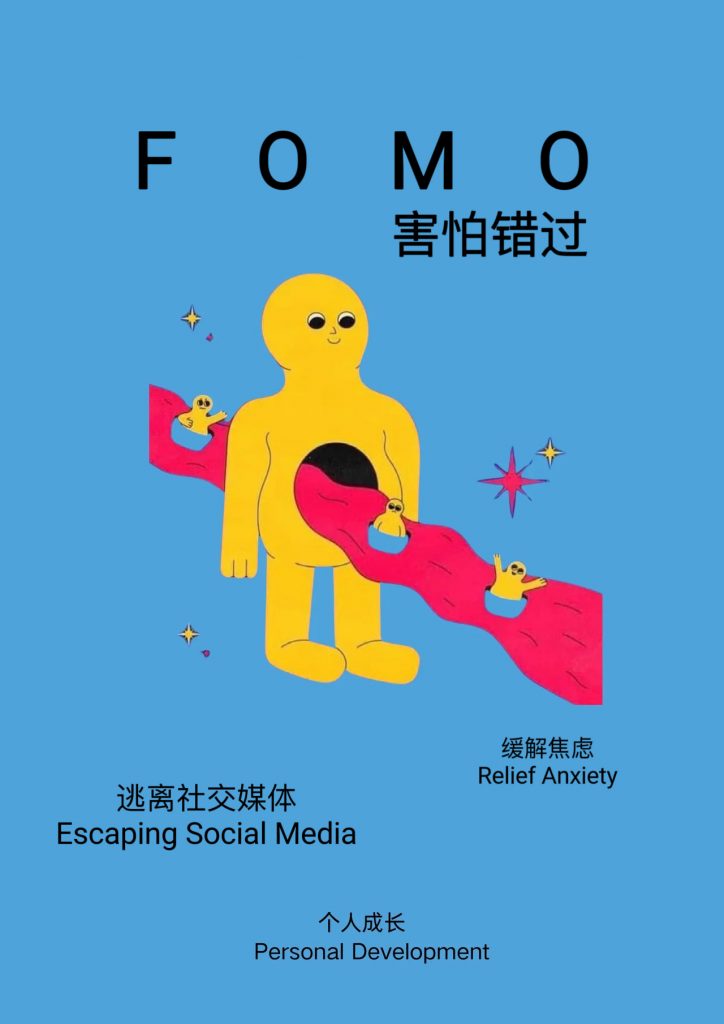
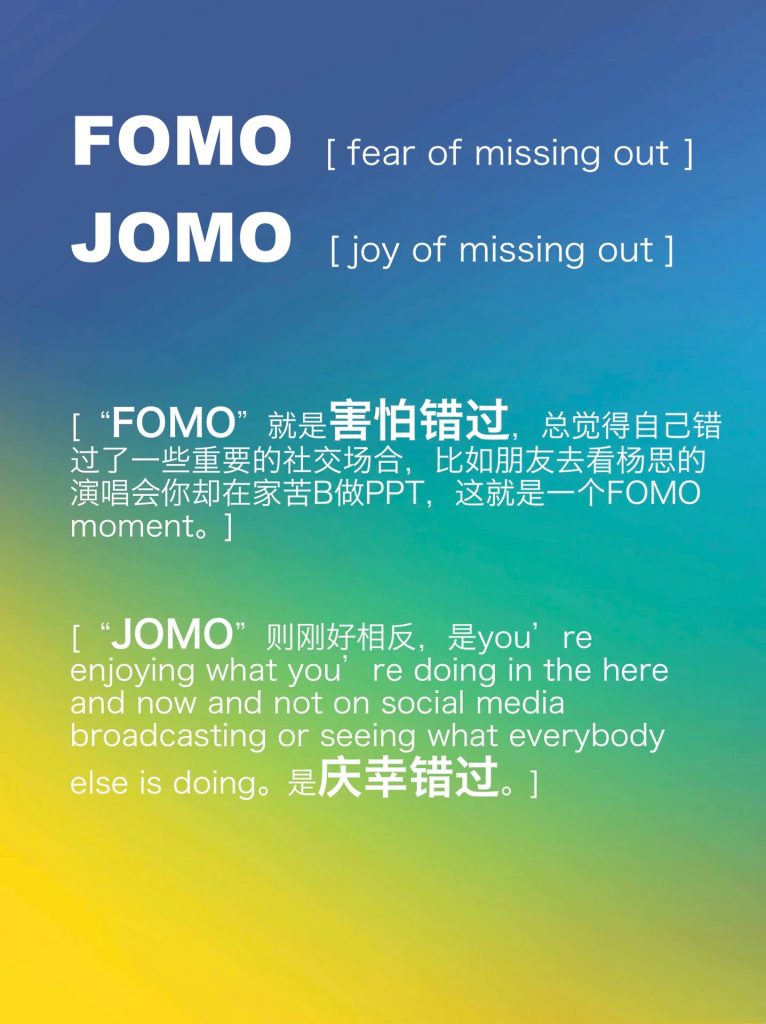
During my last questionnaire at North China Electric Power University, I learnt that in mid-August NHEU would be running a Freshers’ Welcome programme. I originally wanted to create a partnership with the university’s mental health teacher to create a mental health club that would provide a safe space for students to discuss mental health issues and seek help. However, as I am not a student at the university, I was not able to apply for the place and could not provide me with students’ contact details as the teachers at the university needed to protect their privacy. I tried again to contact Mr Zhang from the computer science major. He helped me with a publicity slot at the Freshers’ Welcome, handing out leaflets and e-books on FOMO and anxiety management, including identifying symptoms, coping strategies and information on how to seek help. And after asking people to record the reasons why they felt anxious because of social media and the ways they relieved their anxiety, a number of people left their contact details and I formed a group chat to help people communicate. I wanted to start by spreading awareness and promoting knowledge of FOMO on campus to make sure the target demographic was aware and engaged.